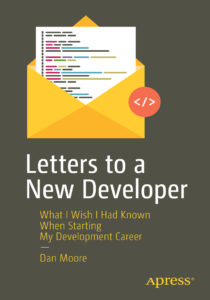
It’s been a few years since I wrote Letters to a New Developer, about what I wish I’d known when I was starting out. The industry has changed with the advent and acceleration of generative AI and the implications of these tools on coding and software creation.
So I wanted to write a quick update to give advice to developers who are entering this world with AI.
It’s important to understand what developers actually do.
They are not responsible for writing code. They are not responsible for liking technology.
Like other employees, developers are responsible for taking their particular skill set and using it to solve problems that a business or organization needs solved. Whether that’s a one-person shop organizing their customers’ data or a large organization like Walmart, Amazon or the US military trying to improve their logistics, there are goals to achieve. For a developer building, maintaining and improving software is the main means to achieve those goals.
This does not change in the world of AI.
The role of a developer is still to understand technology, how it can be applied, where its limits are and to build it with the quality and appropriate flexibility for the business situation.
What do I mean by the last part? If you’re building a script to transfer data from one system to another one time, then a throwaway script that doesn’t have error checking, that doesn’t have proper variable names, that doesn’t have abstraction is appropriate. If, on the other hand, you’re creating foundational architectural components of a long-lived system, you need to think about all the things that make software more maintainable.
In either case as a developer your role is clear. It’s not to code the software. It’s to take the business requirements, understand the domain and build a solution that meets the business’s requirements for a given level of flexibility, complexity and completeness.
That job doesn’t change whether you’re using:
- machine code assembly
- a non-memory managed language like C
- a memory managed language like Java or
- spec-driven development.
As a dev, your job is to understand the technical trade-offs, use the right tools and meet the business or organization’s needs.
Now as a new developer, how do you learn to leverage genAI in a way that is going to help your career rather than hurt it? It’s tough out there to get your job as a new dev and ignoring AI is going to make it even tougher.
It’s important that you learn how to use this tool and use it well. But AI as a tool is much more like Google search results than it is like a compiler error. A compiler error is deterministic and will give you the same message each time you compile the code.
The output of an LLM is not deterministic, just as when you search for guidance for building software on Stack Overflow or your team. With these sources of knowledge, you as a developer need to learn judgment. You need to learn when to trust genAI and when not to trust it.
Do this by starting small, asking for links, and checking the output of an AI against other sources. These include other AIs and published documentation. You’re building your sense of judgment and intuition about the system you are improving. Use it to augment your understanding, not replace it.
When an AI hallucinates, don’t throw the baby out with the bathwater and never touch genAI again. Instead learn to sniff out when an AI is generating garbage and when it is generating helpful code that will accelerate things.
A good course of action is to use AI to generate easily verifiable code where errors are low impact. An example is writing tests with AI, especially unit tests, especially in a statically typed language. It’s very easy to tell if the tests that are written are working or not. Don’t forget to instruct the AI to fully flesh out the tests, you don’t want any “return true” nonsense.
Another example is read-only queries. If you have an understanding of the data you can verify whether or not the SQL the LLM creates gives you the correct answer. Write multiple queries because they are so low effort, and use them to double check answers. If you were looking for a count of a particular set of customers, ask it for multiple different ways, including a count of one particular kind of customer and a count of all customers grouped by type. This lets you see if things match up.
The goal is not trusting blindly but instead using the tool to accelerate delivery of solutions to the problems the business wants you to solve. But you want to do so in a way that is going to give you confidence that the solutions you deliver are real.
By the way, the value of such intuition and judgement is high for all developers.
I think that it’s even more valuable for newer developers.
If you would like to purchase my book, “Letters To a New Developer” for more of this kind of insight, there’s a sale going on right now through the end of the year. You can use this link to buy my book for just $24. (This is a better deal than I get with my author’s discount.)
 Follow me on Twitter
 Follow me on Blue Sky